



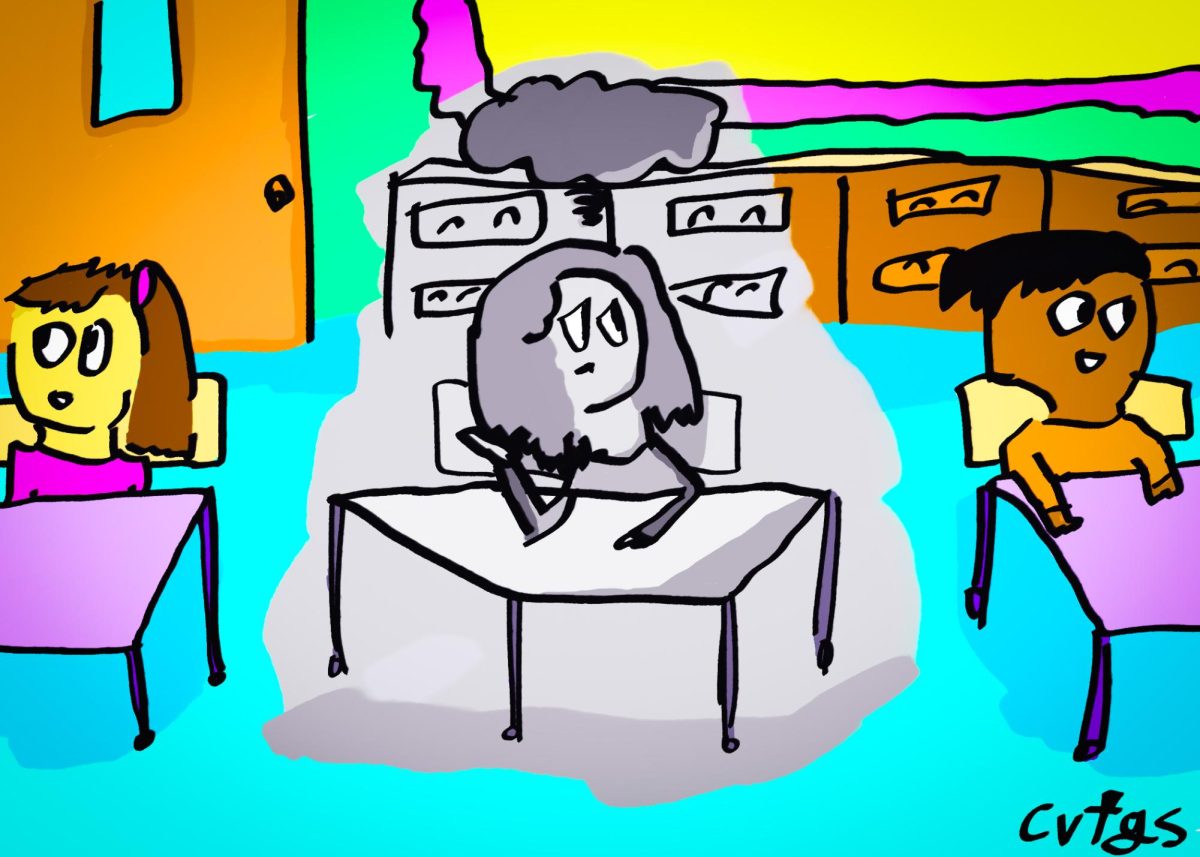
A scientist finally gets her dream assignment. She steadies her hands, fixes the lens and slides a delicate sample under the microscope. Generations of scientists before have studied these complex creatures, but not one could understand them.
She zooms. Inside, the subjects are… underwhelming to say the least. One is on their phone, another is asleep, a few are on Teams pretending to do work.
A girl trips in the hallway. How embarrassing is that?
A boy raises his hand and gets the question wrong. Is he stupid?
Someone walks in the hallways alone. Does she have friends?
Thoughts swirling in the scientist’s head, her only regret is that she forgot to bring popcorn.
Psychologists call this the spotlight effect: the tendency to overestimate how much others may notice or judge us. In other words, we walk around believing there is a spotlight on us, when in reality most people are barely looking our way.
The phrase “Do you think the world revolves around you?” is often one focused on egocentrism.
It assumes everyone has the time, energy and interest to analyze you as deeply as you analyze yourself. With Generation Z’s attention span being about the same as a goldfish, it is almost comical to suggest that you out of all people would be at the top of everyone’s mind.
Yes, I agree Gen Z knows more about others than previous generations. We are the generation that can search up someone’s name and find their mother’s maiden name and address.
But awareness does not equal attention.
In the nicest way possible, nobody cares about you to that degree. That may seem harsh, but the same people you think are analyzing your every move are busy worrying about their own imaginary audience. So no, Big Brother is not watching you through the halls of Coppell High School.
Even if it feels like your most embarrassing moment will go down in history, the reality is far from that. In a few years, that same “embarrassing moment” will barely register. In college, no one will remember who sits alone or if you tripped down the steps of D hall.
Many teens have stopped doing things they once loved, not because they lost interest, but because they are afraid of embarrassment. They quit activities, avoid raising their hands, skip auditions, all in fear that someone might judge them.
Do you want to be sitting on a bench telling your grandkids you avoided something you wanted to do because you were too afraid of others’ judgment?
One time, I was at my cousin’s house and overheard her and her friend debating what to post on their stories. One of them stopped the other mid sentence and said, “Don’t post that, it’s too funny. You do not want people to think you are weird.”
It is a feeling most of us know well, the instinct to not be too loud or different to avoid being seen as embarrassing. But hearing it from her hit differently. She is the kind of person who is filled with energy, the kind of kid who says whatever she is thinking and makes people laugh without trying. It felt wrong watching her tone herself down just to “fit in.”
When you assume you’re being constantly watched, it makes sense that you start adjusting your behavior to match what others expect. Survival of the fittest, right?
You are not Elmo on Sesame Street or Dora on an adventure. You do not have a studio audience watching your every move. There is no laugh track, commentary, or running list of your mistakes. When you start picking apart every small moment, it begins to feel like everything matters more than it actually does. That is the trap, not that people are constantly watching, but you start living like they are.
The microscope you think you are under does not exist. It’s the one you built up in your own head.
Follow @CHSCampusNews on X.






Neev • May 6, 2026 at 1:44 pm
Love this Samara!