


“3…2…1…*CLAP*”
For almost a decade, that sharp clap has echoed through D115 at Coppell High School, cutting through chatter and the clatter of laptop keys to signal the start of work in The Sidekick classroom.
A student picks a word to clap on, and just like that, announcements end and another busy day begins.
Since 2004, Coppell High School’s student newsroom has been D115. Deadlines have been tracked on the whiteboard, stories edited across desks and generations of student journalists have learned to report, write and lead.
Next year, that room will no longer belong to The Sidekick.
As New Tech High @ Coppell relocates into CHS, classes in D hall will relocate, pushing the newspaper staff out of the place that has housed it for decades.
For many current and former staffers, the move marks the end of an era. Not just the loss of a classroom, but the closing of the place that helped shape hundreds of young journalists.

D115 functions differently from most classrooms in the building.
Students are spread across the room – some writing stories, others editing page layouts or checking out cameras for event coverage.
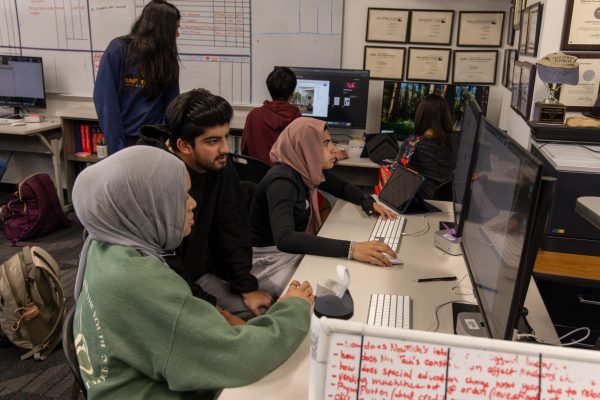
Chairs roll between desks as editors move from desktop to desktop. In different corners of the room, conversations unfold about interviews, headlines or breaking news.
“The room felt different from the rest of CHS because it’s very collaborative. Everything was student-led and student-run,” 2023-24 editor-in-chief Sri Achanta said.
Students gather in the room long before the bell rings and stay well after school ends.
“I used to be in that classroom all the time,” 2022-23 editor-in-chief Angelina Liu said. “Even when it wasn’t my Sidekick period, I still went anyway just to hang out. D115 has always been a place of happiness and joy.”
Because the room functions more like a newsroom than a class, the work inside is rarely confined to when the bell rings.
“You would go there before school, during lunch, after school – whenever you needed to finish something,” 2023-24 features editor Anushree De said. “It never really felt like a classroom. It felt like a place people actively used and depended on.”
For many staffers, it becomes the place they spend the most time in during high school.
“In high school everyone has that one place they spend the most time, whether it’s art, a sport or a club,” 2024-25 editor-in-chief Sukirtha Muthiah said. “For me that was Sidekick. D115 felt like home base.”

Beyond the reporting and editing that takes place inside D115, its traditions developed over the years.
Walking into the room, a whiteboard on the right spans nearly an entire wall, filled with story slugs, deadlines and assignments written in multicolored Expo marker. Every adjacent wall carries copious awards spanning decades.
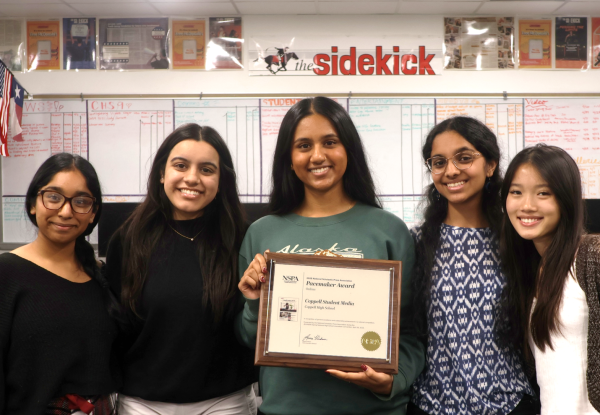
“The whiteboard is what made the room feel like a newsroom,” 2024-25 managing editor Nrithya Mahesh said. “Seeing the whiteboard filled with stories made you realize how much reporting was happening at once. Whenever you look at all the achievements on the wall, the board in all of its glory and the papers on the wall, it really makes you realize the history of the room you’re in.”
Other features, though less formal, were just as memorable.
Students often gathered on a worn couch, discarded in 2025, in the center of the room, working on laptops side by side while discussing stories or offering editing help.
“The couch was broken and not even that comfortable, but everyone still chose to sit on the couch,” 2024-25 staff writer Neha Nathwani said.
The physical layout encourages collaboration. Computers line the walls while circular-arranged desks fill the middle, allowing students to meet and discuss easily.
“The layout of the classroom was perfect,” Achanta said. “All the computers were around the outside of the room, so you could easily walk around and look at everyone’s work.”
Those details helped turn D115 into more than just a classroom. It became a place people gravitated towards throughout the day.
“It became a gathering place,” Liu said. “Most of the time I could pop in and my friends would be there.”
Students regularly stop by during lunch or free periods, even without work to finish.
“There was always someone there,” 2023-24 social media manager Sameeha Syed said. “You could come early or stay late, sit and talk with people and still get your work done.”
The connections made inside D115 often left indelible marks well beyond high school. For Nathwani, the sense of community stood out as much as the technical skills she learned.
“In an emotional sense, the biggest thing I took from Sidekick was the sense of community,” Nathwani said. “Having a community in high school was really important to me.”
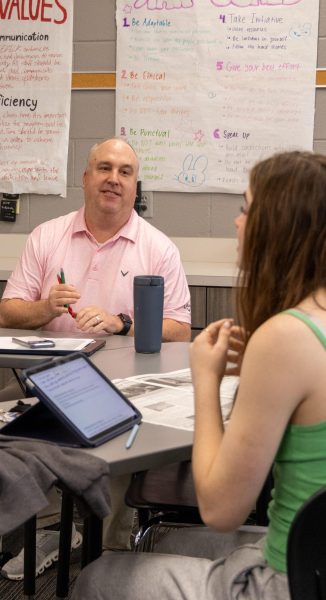
For many, the room’s identity is also inseparable from its adviser – Chase Wofford.
“When I hear D115, the first thing that comes to mind is actually Mr. Wofford,” Achanta said. “He makes the newsroom what it is. He has such a big impact on every student who goes through the program.”
Students and graduates describe Wofford as the force behind the collaborative energy and professional rigor of the room.
“Sidekick wouldn’t be Sidekick without Mr. Wofford,” Nathwani said. “He’s really good at pushing people to unlock their highest potential, seeing what people are good at and helping them grow.”
2008-09 web editor Vidushi Shrimali recalls the impact on her career decades later.
“I don’t remember many of my teachers’ names, but I always remember his. He was the first person who made me realize you could make a living writing and telling people’s stories,” Shrimali said.
Prior to Wofford becoming adviser in 2005, former The Sidekick adviser Gail Richardson led the program.
“Both of them were outstanding and critical for my development as a journalist at the time and as a professional now,” 2006-07 editor-in-chief Ross Taylor said.

While the physical space is iconic to many staff members, the impact of D115 extends beyond its four walls.
For many students, their first experience with journalism took place in D115. Students were introduced to professional, real world journalism, and entered the field.
“I joined sophomore year, thinking it would be a fun activity just because I liked writing. I didn’t expect it to become something I was so passionate about,” Muthiah said.
Others discovered the importance of storytelling through reporting.
“Being features editor made me realize how much I love listening to people’s stories,” De said. “That ability to listen to people and help them tell their stories is something that has stayed with me.”
For some graduates, their experiences shaped academic and professional paths.
“Being in The Sidekick absolutely shaped my decision to study journalism,” Liu said. “When I got to college, I felt 10 times ahead of my peers because of the newsroom Mr. Wofford ran.”
The program evolved alongside the changing media landscape. In 2008, The Sidekick expanded online with the launch of CoppellStudentMedia.com, giving students early experience with digital journalism.
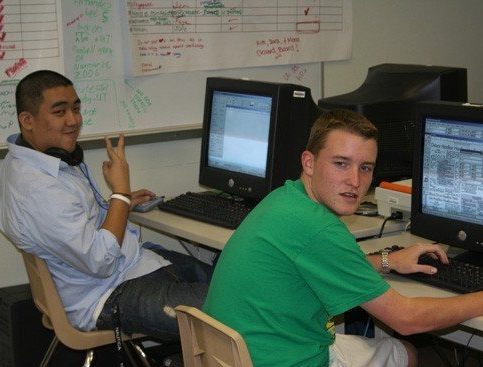
“I was the first web editor,” Shrimali said. “That was just the direction journalism was going. Moving online was what publications had to do to survive.”
The site gave students exposure to skills that would later become standard. Students gained practice with digital media the industry was starting to use.
“I’ve been so impressed with everything The Sidekick has done since I left,” Taylor said. “To see this evolution, that all of the young people of CHS have transitioned into something truly living and breathing.”

In 2020, the COVID-19 pandemic suddenly disrupted that community.
Students had to work remotely instead of gathering in the newsroom. 2020-21 editor-in-chief Sally Parampottil remembers the shift.
“There was a certain musicality to D115,” Parampottil said. “You would hear laughter, people talking, keyboards typing and mice clicking while people designed pages.”
When she returned to the building at the end of her junior year, the room felt unfamiliar.
“I remembered the newsroom as a place that was always lively, but suddenly there were maybe three people in the room,” Parampotti said. “It felt like this liminal space – something was missing.”
Editors attempted to recreate the newsroom environment online through Slack messages, Zoom meetings and digital storyboards.“It was hard to recreate the organic conversations you normally have in a newsroom,” Parampotti said. “On Zoom you have to unmute and wait your turn. In a newsroom, you can overhear someone talking and jump into the conversation.”
Despite the challenges, the staff continued cranking out stories and publishing issues.
“The job still got done,” Parampotti said.

Although the newsroom will soon move to a new location, graduates say the identity of The Sidekick is not tied just to one classroom.
“Knowing how much history is in that room makes it sad to leave,” Mahesh said. “The room feels almost synonymous with Sidekick.”
Still, she believes the program will adapt.
“At the same time, it’s not the end of Sidekick. It’s just the end of that room,” Mahesh said.
Many graduates echo the same idea: D115 mattered, but the people inside it matter more.
“As long as the people stay, the program will still be the same,” De said.
Even for students who will never set foot inside D115, the legacy of the room will remain etched into the program’s history.
“Maybe it is a little sad to see it moving,” Taylor said. “But the heartbeat of The Sidekick will go wherever young people are passionate about this.”
Follow @CHSCampusNews on X.







Neev Chickermane • Apr 7, 2026 at 11:37 am
Love this Hamza!!