(Sofia Exposito )
Amidst looming budget deficits, consolidations and legal scrutiny, Coppell ISD is no stranger to making adaptations in order to preserve educational quality.
Taking effect as law on June 20, House Bill 1481 amends Texas Education Code §37.082 and requires the implementation of policies prohibiting the use of any personal communication devices by students on school property during the school day. All public school and open-enrollment charter school districts across the state must create and enforce a written policy by Sept. 18, while failure to comply can lead to state funding loss or investigation by the Texas Education Administration.
The law is applicable to all Texas public school districts and open-enrollment charter schools, with exceptions for students with documented medical or disability-related needs.
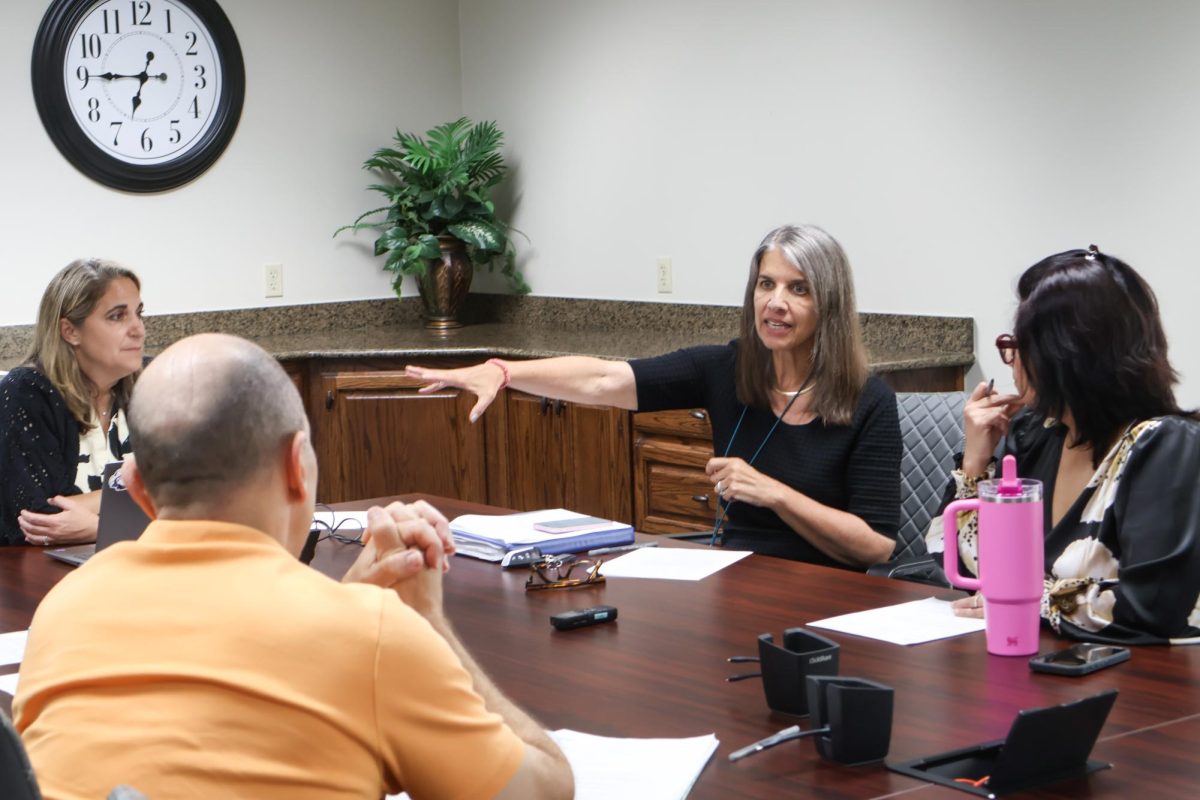
”One of my biggest worries was, ‘what’s that going to do to the culture of what we’re trying to build here?” Coppell High School Principal Laura Springer said. “A culture of love and support for each other to make everybody feel welcome and cared for. It’s hard to do that with some of the laws we have right now. I knew that it was going to be a problem and we’re going to have to try to offset that as best we can. I think sometimes the legislature doesn’t really know what’s happening in our high schools, so I think it kind of started a year off with a not good taste in everybody’s mouth.”
Though the TEA was allocated $20 million in state grant funding intended to aid school systems in purchasing storage solutions and implementing the device ban, under HB 1481, schools are responsible for applying and managing implementation on their own accords.
The enforced policies must also detail the disciplinary measures taken when the law is violated. This can include device confiscation, device disposal and written notices to a parent or guardian at least 90 days before disposal.
At CHS, the operating bell schedule restricts the use of personal devices from 8:50 a.m. to 4:15 p.m. daily. High school and middle school students must keep cell phones and smart watches secured in school-issued Velcro pouches throughout the school day. Devices such as tablets and laptops must be kept shut off in backpacks or left at home.
For student media programs at CHS, such as KCBY-TV, the personal device ban has a number of implications on production and workflow.
“The school MacBooks are great, but at the end of the day, our personal MacBooks are just leaps ahead,” KCBY program director and senior Aaron Montes said. “And with that, we get slower and slower export, edit and render times, so it really pushes us back a while. In general, the media policy kind of hinders us because we have a lot of stuff that needs to go out.”
To accommodate students seeking resistance to the new laws, public Wi-Fi access for personal communication devices have also been disabled during instructional hours.
“We knew we were going to have kids who were like, ‘I’m just not going to do that.’ We hear you, we know you’re frustrated by this, but like anything, if you’re told by a law you can’t do something, you don’t do it,” Springer said. “This is a rule coming down from the state of Texas, not a campus rule. We already had our own version of it with our phone pockets hanging on the walls, but we have to enforce this now, 100%.”
Hanging cell phone pocket organizers were put in place at CHS to cultivate distraction-free zones during instructional times prior to the legislation implored a bell-to-bell policy.
”At first, it seemed like a no-brainer to me that they had put in a new rule especially for younger teens that tend to get distracted by technology. I was wondering ‘Why wasn’t this done sooner?,” CHS9 PTSO parent Anshul Singh said. “But when I think about what I’ve been seeing so much on the news recently, I start to think, ‘Well, what if my child has an emergency and I’m the last to hear about it?’”
Despite being one of the more standout issues within the new policies brought forth by recent legislation, it is only one aspect of a broader wave of changes affecting Texas public schools. Several other new laws passed by legislation will reshape the current educational landscape in terms of administrative oversight, classroom management and mandated curriculum.
“Sometimes the legislature doesn’t really know what’s happening in our high schools, so it can be difficult and even a little frustrating, but it’ll be something we’ll all have to adapt to over time,” Springer said.
As part of the state 2025 budget and education legislation, House Bill 2, signed into law on June 4, increases the salaries of teachers and public school employees through the Teacher Retention Allotment. Additionally, non-administrative school staff, such as counselors, librarians, nurses and other campus support, will also see pay raises due to the allocated funds from the Support Staff Retention Allotment, and an expanded Teacher Incentive Allotment allows for experienced, high-performing teachers to receive a rise in payouts depending on district size.
As one of the larger education bills enacted during the House’s 89th legislative session, HB 2 adds approximately $8.5 billion into Texas public education. This marks the largest boost in funding for education since HB 3 in 2019, passed by Governor Greg Abbott in a landmark finance bill increasing the basic allotment for public schools from $5,140 to $6,160 per student.
Special education is also impacted by HB 2, seeing an allocated $834 million in funding beginning in the 2025-26 school year. The bill establishes fee waivers for teachers seeking certifications in special education and provides incentives for uncertified individuals to address problems with retention and short staffing.
HB 2 additionally expands eligibility criteria towards pre-K programs by including the children of public school teachers while emphasizing support for low-income and bilingual students. Efforts to alter the existing funding system were also detailed within the bill, ensuring children with disabilities to be eligible for pre-K.
HB 6, a law aiming to enhance teacher authority and address student discipline, comes as a response to reported increases in disruptive behavior following the COVID-19 pandemic. Teachers are permitted to remove disruptive students from classrooms based on singular instances of misconduct, while circumstances for suspension are also expanded.
Senate Bills 10 and 11 place mandates on religious expression, such as permitting school boards to vote on implementing designated periods for prayer time and the requirement for all Texas public schools to visibly display the Ten Commandments in classrooms. While schools are not required to purchase the displays themselves, posters and copies of the Ten Commandments privately donated or given must be displayed.
“It kind of comes as a shock to me, even as a Catholic,” senior Jessica Paulino said. “As much as I would appreciate the idea of spreading the gospel further and getting people interested in religion, I don’t think this is the way to do it, whether or not it’s a law. It’s interesting being in an AP Government class while stuff like this is actively happening.”
On Aug. 20, a federal judge issued preliminary injunctions blocking SB 10’s implementation for multiple school districts.
“Since Texas is a state that tends to act as a testing ground for more conservative educational policies, it’s likely that other conservative states will later end up adopting the same or similar legislation,” Chief of Staff and General Counsel at Texas Senate Pearl Cruz said. “It’s no doubt that other states like Florida may end up becoming influenced by the precedents we have here and introduce bills to reflect that.”
SB 12 prohibits Diversity, Equity and Inclusion from being taught or promoted in K-12 schools. Teachers are also prohibited from using pronouns and names for students that do not match their assigned sex at birth or legal name.
At CHS, the club application process has been revised to require parental consent forms for student participation in school-sponsored clubs, extracurricular and Career and Technical Student Organizations.
”Over the summer, we had a meeting for all of our staff here and we kind of just said, OK, here’s what’s happening and here’s how that’s going to look from here on out,” Springer said. “We talked about it, worked on it and now we just call people by their last name.”
SB 13 increases the oversight parents have over library materials, ensuring access to local library catalogs, permitting requests for the removal of books and requiring districts to create local advisory councils to manage sensitive library material. English teachers have turned to placing papers over shelves in classrooms containing books with subject material that may be deemed inappropriate.
Shifting the focus back to curriculum, SB 24 requires TEKS (Texas Essential Knowledge and Skills) to include teachings on communist ideologies. The bill intends to promote the values of democracy and civic engagement to students and denounce the dangers of totalitarian regimes.
The sum of the legislation passed during the 89th session reflects the need for schools, namely educators, to adapt and navigate ongoing shifts to the teaching landscape over time. Though the long-term effects of the 1,045 new bills signed into law by Governor Abbott remain unknown, Texas classrooms are guaranteed to look drastically different in the coming years.
The introduction of new bills simultaneously draws attention to heightened state authority over education in local school districts, rather than leaving it up to municipal governments.
“Traditionally, municipalities would have a lot more flexibility in areas like curriculum, teacher salary and local libraries,” Cruz said. “While legislation wants the most consistency out of the new bills being passed to be standard across the state, it does also come as a compromise for local communities to make those decisions for themselves.”
Keeping students at the forefront of all the new changes, Springer thinks it will not change Coppell’s mission.
“My business is students,” Springer said. “It’s young people, it’s teaching young people things, it’s loving young people for who they are. We’re all learning, we’re adapting to changes the best we can, and we’re going to continue being the school we are and who we love to be.”
Follow Caitlyn (@caitlyncion) and @CHSCampusNews on X.