



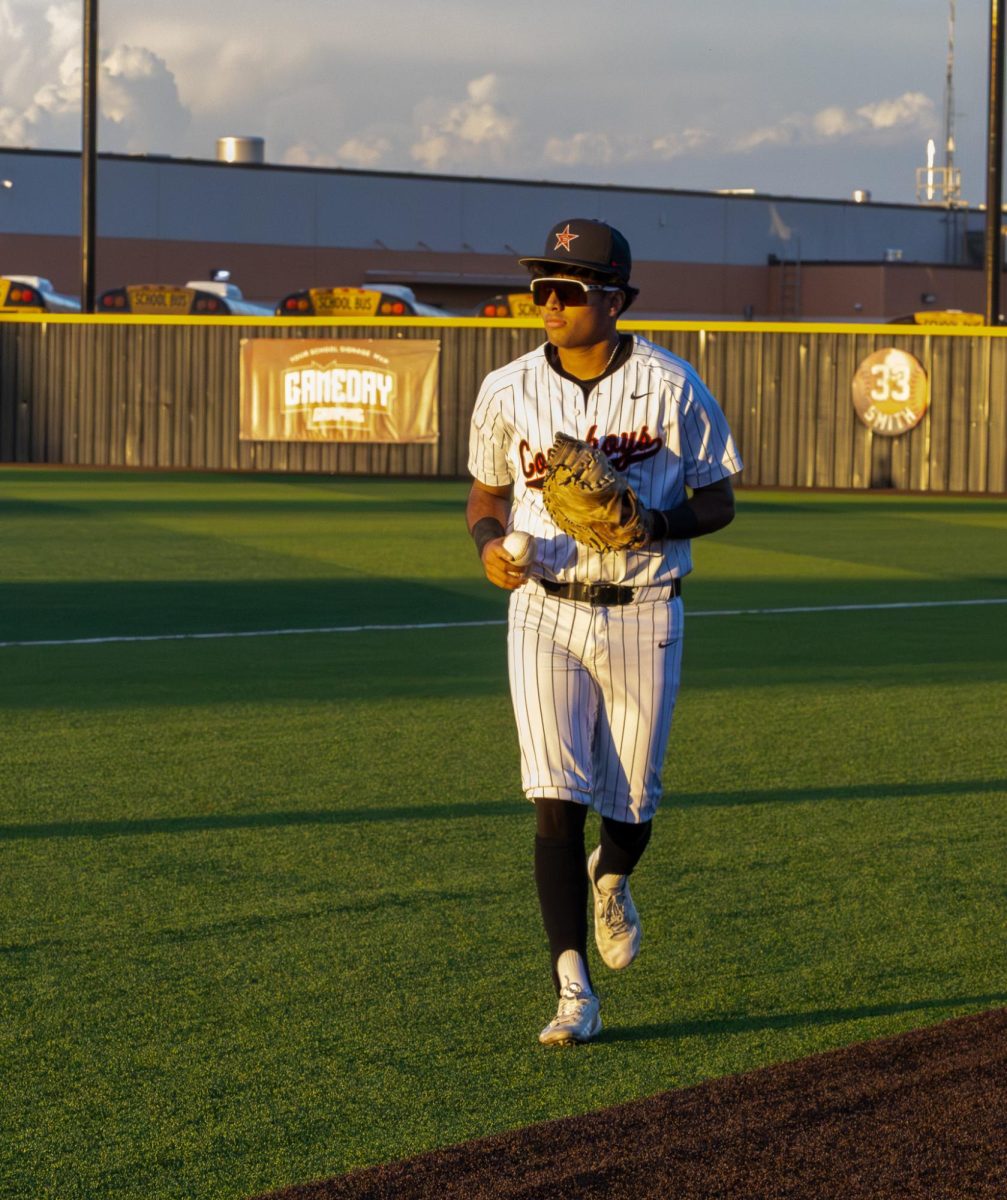
As each run is scored, New Tech High @ Coppell senior Nathan Fan cheers, but his voice doesn’t blend in with the rest of the crowd. His voice booms from the speakers, describing each play. Fan is a part of Coppell Athletic Media, a student-led program creating various media behind the scenes at games. He has worked in many mediums and is set to work as a camera man and commentator for baseball season.
What drew you to videography and behind the bench activities rather than just doing the sport itself?
I’ve played sports for 8-10 years of my life. I know what it feels like to be on that field, performing in front of cameras, in front of a crowd, and I wanted to see what it’s actually like backstage being on the mic, being on the camera, and creating those moments. Right now I’m just dabbling in it, and I would like to continue that when I go into college and the future.
Can you tell me about your work with CAM?
Last year I was a camera operator for the basketball and volleyball games at Coppell High School Arena, and over the summer, unrelated to CAM, I was able to hop in the booth of a Texas Rangers national broadcast game for the radio. That really got me thinking, wow, I kind of want to try this whole getting on the mic thing. Then when this year rolled around, I asked our director if there were any commentary spots available. First he told me that for the football season, I would be allowed to shadow the commentators since they weren’t with CAM. So I sat in for the season, shadowed them, and got my hours there. When soccer season rolled around, I was ready to hop on the mic and do our streams.
What does your work contribute to the game?
You see the athletes performing, right? But you can also get the point of view of the broadcasters. You get to feel the emotion that we feel, because if you’re doing TV commentary, let’s say, as a viewer, you can see the game going on, you’re just filling in little details here. But if you’re doing radio commentary, you are the eyes and the ears for the viewer. You describe every little thing that’s going on, and you are helping make memories for the viewers. That’s why I’ve always had a passion for helping people in many different ways, either at church, or volunteering. Making memories for people or making games more accessible for others.
How did you get your position as an announcer?
The guys that offered me this opportunity were the guys that I shadowed for football, and they do the exact same thing for baseball. They don’t come from CAM. They come from an outside organization called Champion Sports Radio, and it’s this Dallas high school sports radio organization. Since I shadowed them for football, they knew who I was. They know I love baseball and they reached out to [Coppell ISD scoreboard video producer Ryan Putman], who reached out to me asking if I was interested in coming on with them, as a cameraman and as the announcer or commentator for the baseball games for the latter half of the season. And I was like, “absolutely, man.” That’s kind of how you get opportunities in the sports media industry, it’s word of mouth. Once you get that first foot in the door, you’re going to have opportunities.
How did you get your foot in the door?
It would be when I reached out to the Texas Rangers broadcaster last summer, this was an absolute stab in the dark. I was trying to get my foot in the door and I reached out to them, hey, is it possible I can come see how we all operate on a game day? How does radio work? And to my surprise, the broadcaster actually got back to me and they said, yeah, we’ll arrange a date, arrange a game, and they got me on for a national broadcast that day. I was in there, up in the booth for a couple of innings, and now we’re great buddies. I’m going to redo it this summer again, so I’m still with the Texas Rangers.
Is there any advice you’d like to give?
There’s something I always love to tell students and people that are looking to improve themselves for opportunities, and you’ve probably heard this before. If you don’t ask, the answer is always no. If you want the opportunity, go out, do your work, do your homework, seek the opportunity, find what you want to do, even if you don’t know what you want to do. I didn’t know what I wanted to do last year. I was testing out cameras, and now I’m doing commentary. If you told me a year ago that I’ll be on stream for the Cowboys, I would have said, “you’re lying.” But being in sports media has given me so many opportunities and so many ways that I can help people or impact other people’s lives. Maybe just providing one electric goal call, or maybe I’m giving someone feedback on their cinematography. You don’t know. So, if you don’t ask, the answer is always no.
Follow @SidekickSports on X.



Nathan Fan • Apr 11, 2026 at 11:07 pm
Thank you for having me!