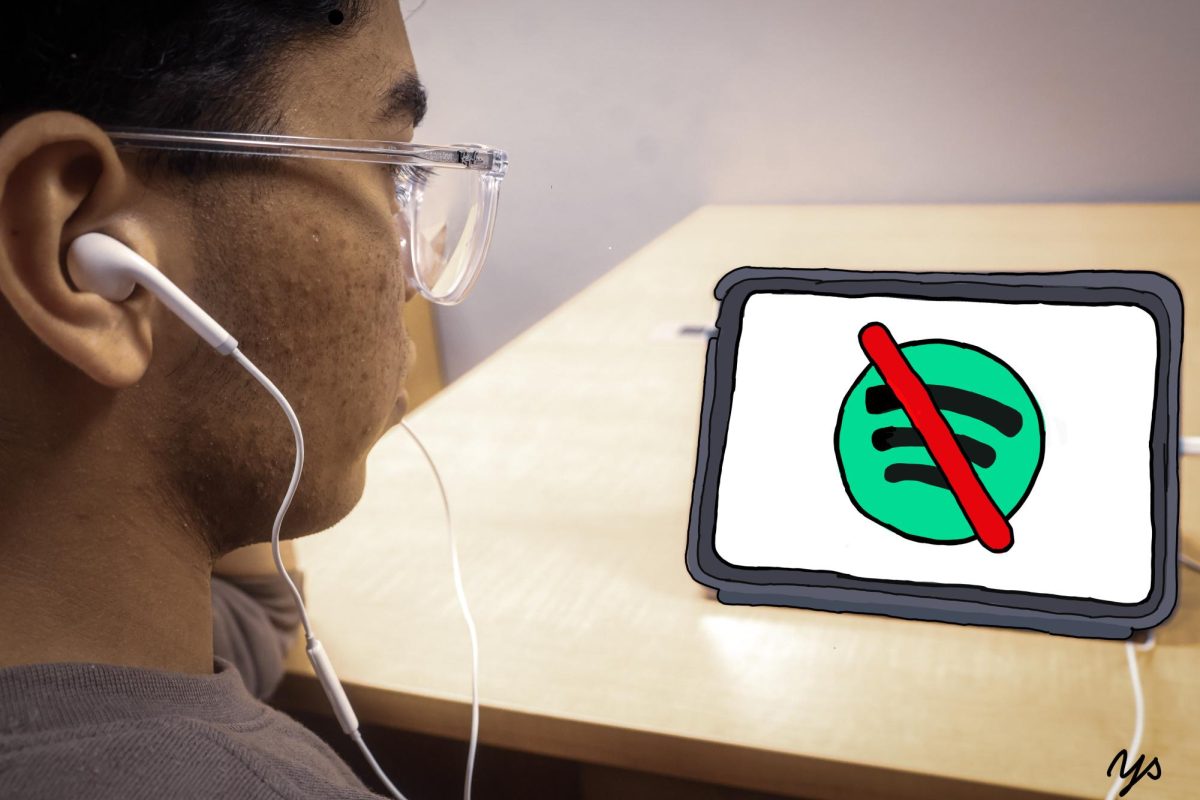
With the simple click of earbuds or headphones into the charging port of an iPad, any student can stream the thousands of songs available on Spotify. Such is the daily routine of many students at Coppell High School.
This is no longer the case.
In December, Coppell ISD indefinitely restricted the music streaming platform Spotify, preventing students across the district from accessing the popular music platform.
“I was like ‘wait’ and I was pretty mad, because Spotify is not just a listening app,” junior Aniketh Vakayil Maheshkumar said. “It helps me concentrate and focus. I know that a lot of people would agree with me.”
This restriction comes with the district following Spotify’s Terms of Service.
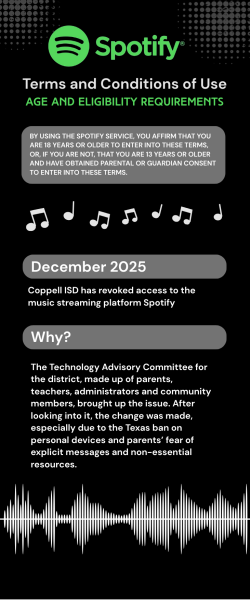
“The Spotify Terms of Service requires users to be 18 unless permitted by the parents or guardians,” CISD executive director of technology Dwight Goodwin said. “We are not banning Spotify nor similar streaming services; we are abiding by their terms of service.”
Prior, it was common to see students listening to their favorite artists while working or walking in the halls. Since House Bill 1481 bans the use of personal devices on school campuses, connection through district-issued iPads was their only choice.
With the many crackdowns, such as restrictions on media and entertainment related websites such as X, coolmathgames or YouTube Music in the district, students think it is unfair that they do not have a say in the decisions.
“I think them following the terms of service is kind of like censorship, honestly,” junior Sahiti Godavarthi said. “I think they are doing this so that we don’t get access to certain types of music. Since they do not have the ability to ban certain music on Spotify, now they are using the terms of service as kind of an excuse.”
Aided by this is the Child Internet Protection Act (CIPA), requiring federally funded schools to block students’ access to obscene content and harmful material.
“These are district-owned devices, and we have to follow state and federal regulations like CIPA and HIPAA to maintain student safety and data privacy,” Goodwin said.
This decision was not made alone. CISD considered the opinions of many staff and parents across the district.
“The district has a Technology Advisory Committee made up of parents, teachers, administrators and community members who brought up the issue, and after looking into it, the change was made,” Goodwin said.
Many believe that this restriction could cause a chain reaction, leading to other bans.
“I’m a firm believer that when you close one door, people are going to find a reason to kick down another one,” English teacher Stephen Patino said. “Sure, they’ve shut down Spotify, but what about YouTube, Apple Music and SoundCloud? There are still a bunch of sources out there.”
The restriction is limited to student devices. While teachers are not necessarily impacted, many have observed the reactions and sentiments of the student body.
“When it comes to Spotify, there are a lot of social features on it,” Patino said. “When it comes to Gen Z in particular, playlists are a huge part of their listening habits and then being able to share those playlists and songs with each other.”
Currently, the restriction will be in place as long as Spotify terms of service remain the same. Although the decision has disappointed students across grades, music continues to connect them.
“Everyone speaks different languages or understands language differently, but music is like an art – an art form that connects people,” Maheshkumar said. “With such a strong connection, I think that’s why Spotify was such an important thing for the student body.”
Follow @CHSCampusNews on X.