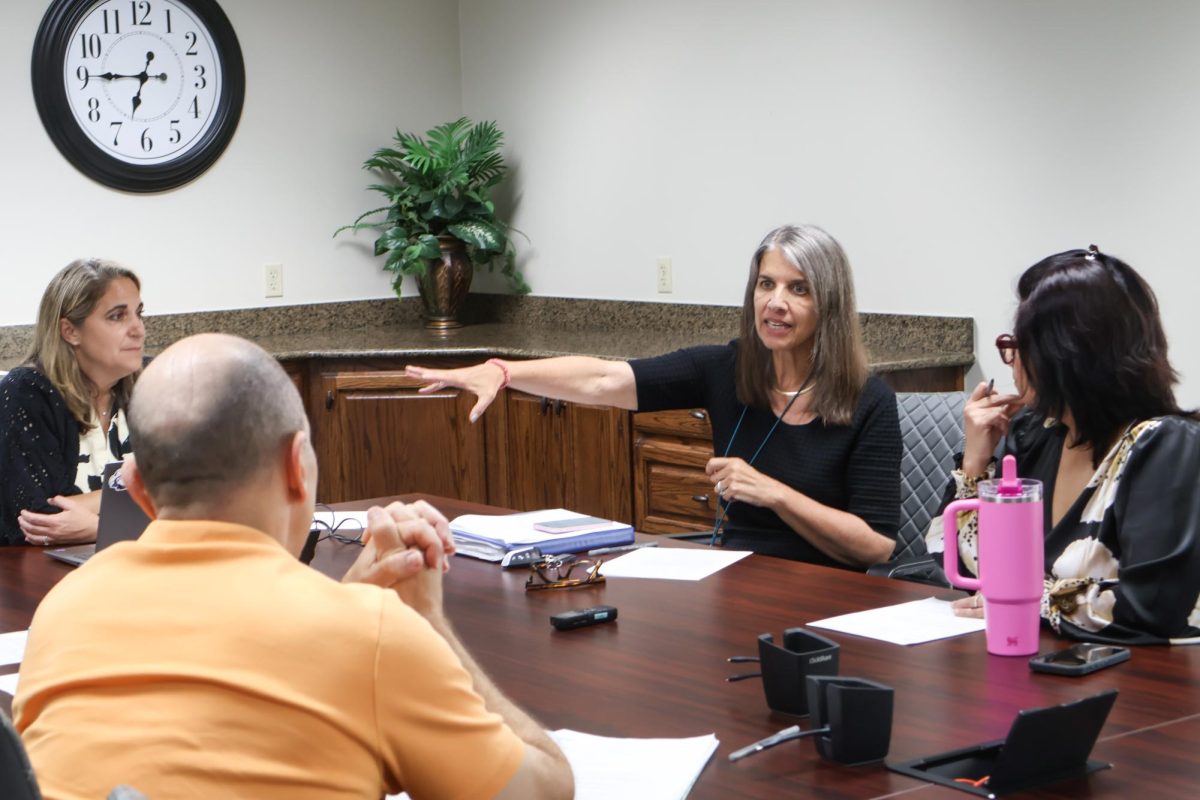
On Monday, the Coppell Smart City Board held its final meeting for the year, focusing on three proposals to the city.
Board member Michael Cash introduced the first proposal regarding smart irrigation rebate program.
“In the U.S. there are about eight million gallons of water used each day for landscaping and about 50 percent of that is estimated to be wasted,” Cash said. “The Smart City Board is looking at smart irrigation, a technology-driven solution using real-time sensors and intelligent controllers to reduce water waste while providing measurable financial benefits to the city.”
For the rebate, the Board is considering the proposal of an actual cash coupon rebate or reductions in the water bill for Coppell residents up to $150.
The next proposal the Board discussed was satellite-based leak detection, which is estimated to save hundreds of thousands of dollars annually for the city.
“Right now the way you detect leaks is when the water reaches the surface, wasting a lot of time,” Cash said. “Satellite detection uses specified radar with satellites to find treated drinking water in the soil.”
This system is said to increase efficiency for finding leaks, saving money and improving Coppell’s carbon footprint through less water waste.
“Garland was one of the top use cases,” Cash said. “They’re projected to save 232.1 million gallons of water per year and a total savings of $696,000.”
The Board believes it should focus on the satellite-based leak detection when presenting proposals to the City of Coppell due to its efficiency and potential to save money.
“I see the number 700,000 in savings and now I’m interested,” Board member Kanishka Chaudhuri said. “If Garland can do that and all my neighbors are doing it, I want to do it.”
The final proposal focused on a rainwater harvesting system.
“There is about 38 inches of rainfall every year, with a 2,000 square-foot roof you should be able to capture about 40,000 gallons of water,” Cash said. “Putting that into perspective, if you’re in a subdivision of 100 houses, multiply that and you have four million gallons of water saved.”
The rainwater harvesting system is planned to start in small phases, beginning with barrels from hardware stores and then expanding it to schools, stores and neighborhoods.
In 2026, the Smart City Board will focus on robots and humanoids in the city and the implementation of microgrids.
Follow @CHSCampusNews on X.